The Thread and the Edge: Demystifying the Micro-Details of a RYAN London Leather Case
 Craig Mercure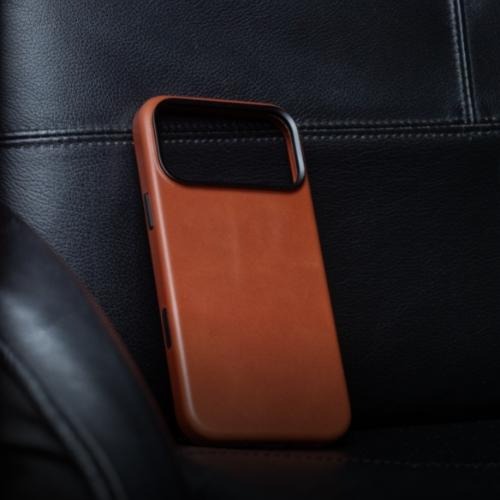
Luxury is easy to claim from a distance.
Under a lens, it is far harder to fake. A truly handcrafted luxury phone case reveals its worth in the fine joins, cuts, and sealed edges that most people feel long before they think to inspect them.
That’s why a close look at RYAN London iPhone cases is useful. The case can be read like a fine bag or wallet: stitch by stitch, edge by edge and cutout by cutout.
Start With the Stitch Line
Set a mass-made case beside a well-made leather one. On the basic case, gaps may vary. A thread may sit loose, lean out of line, or sink too far into the hide. At a corner, the seam may bunch as the machine fights the curve.
On a RYAN London case, the stitch line is tight and even. Dense rows of German nylon thread hold the leather in place without making the seam look thick. Each loop has firm, calm tension. No point looks pulled, slack or set at odds with the next.
That balance matters. A loose stitch can catch and fray. One pulled too hard can cut into the leather. The right tension helps the seam cope with grip, heat and daily trips in and out of a pocket. It is a small sign of high-end leather-goods craftsmanship, yet it has a clear purpose.
Inspect the Edge, Not Just the Face
The front grain gets most of the praise, but the edge often tells the full truth. A low-cost cover may have a raw edge or a thin coat of paint laid on in one pass. Soon, the finish can chip, split or peel from the core.
A premium leather smartphone cover needs more care. RYAN London uses several hand-set layers of premium edge paint. Each layer is heated and set before the next is added. This builds a smooth, sealed rim rather than a skin that sits on top.
Run a finger around the frame. A fine edge should feel full and level, with no sharp lip, bare fibre or wave. Look near a corner, button or port, where weak coats often thin out. The finish should stay neat as the line bends. This is slow work, but it guards the edge from wear and gives the case a clean, framed look.
Look at the Lower Frame
The base is where design and craft must act as one. An open base is easy to shape but leaves more of the phone exposed. A closed-bottom design has to fit around the charge port, speakers and mic with far less room for error.
The cutouts should align with the phone. They must be wide enough to work, yet not so wide that the base loses form. On a well-cut case, the lower rail feels like part of the shell rather than a thin strip added at the end.
That full frame can help keep the base firm and shield its corners. It also gives the leather edge one clear path around the phone. Poor cuts will look rough, off-centre or weak at the narrow points. Precise ones keep both access and shape.
Feel the Inner Lining
Consider the surface you rarely see. The interior is lined with a dense microfiber fitted exactly to the shell. A basic case often leaves ragged seams where this lining meets the leather lip. Here, the transition is seamless. It forms a uniform bed that guards against micro-scratches, proving true craft does not stop where the eye cannot reach.
Use a Simple Lens Test
Good craft should hold up at close range. Check that stitches keep the same pace. Press the edge and watch for cracks or lift. Trace each port to see if the cut is clean. Then view the case as a whole: every small part should lead into the next.
That is the real anatomy of quality. Fine leather matters, but leather alone does not make a refined case. The lasting value lies in the thread that stays set, the edge built in layers and the lower frame cut with care. Under a lens, those details turn an everyday cover into a piece of craft.